Each year at the end of March, the USDA releases their Prospective Plantings report, and we analyze the results for you. This report includes information surrounding estimated crop plantings for the current year as well as harvest information such as area harvested and yields for the prior and current year. The principal crops included in this report are: corn, all wheat, winter wheat, durum wheat, other spring wheat, oats, barley, flaxseed, cotton, rice, all sorghum, sweet potatoes, dry edible beans, soybeans, sunflower, peanuts, sugarbeets, canola, proso millet, hay, tobacco, and sugarcane.
Planting Expectations
When looking at overall acreage of these 22 principal crops in the United States, the USDA expects a total of 310 million acres to be used this year. In 2025, the USDA predicted 309.9 million acres, with actual numbers falling at 311.5 million acres, meaning that planting surpassed expectations last year and this year the USDA is predicting a slightly decreased overall planting acreage.
This year, major planting highlights include:
- Corn Planted Acreage Down 3 Percent from 2025: Estimated at 95.3 million acres, 37 of the 48 estimating states are expecting stable or decreased acreage.
- Soybean Acreage Up 4 Percent: Estimated at 84.7 million acres, 20 of the 29 estimating states are expecting stable or increased acreage.
- All Wheat Acreage Down 3 Percent: Estimated at 4.38 million acres overall, which if true will mark the lowest acreage of all wheat since recording began in 1919.
- All Cotton Acreage Up 4 Percent: Estimated at 9.64 million acres overall. American Pima is estimated at 130,000 acres which is an 8% decrease from 2025.
When we compare this data to the 2025 Prospective Plantings report and numbers from 2024, we see some shifts in predictions happening. The year 2024 brought predictions of a corn decrease (-5%) and soybean increase (3%), 2025 had predictions of a corn increase (5%) and soybean decrease (-4%), and 2026 is again expecting a corn decrease (-3%) and soybean increase (4%).
All Wheat was forecasted and came in down 2% last year, and is forecasted at 3% this year. All Cotton seems to be dropping a little, but maintaining a new normal after a major decrease of 17% in 2025 which was 5% higher than the estimated 12%. American Pima is showing the larger decreases with an expected drop of 8% which Upland is expecting to increase by 4%.
Experts agree that while these numbers reflect many trade estimates, there are still a large number of watch outs to keep an eye on. The war in Iran is causing volatile fertilizer prices, most of which hit the market after the time of survey collection. Increasing fertilizer costs mixed with an already high supply of corn could shift farmers away from corn, a more fertilizer intense crop, towards soybeans which use less fertilizer. We are also experiencing uneven purchases of soybeans from China, threatening the value of the market incentives of soybeans, weighing on a different part of the market.
Harvest 2024 Data
The harvest charts focus on the 2025 data in full. When compared to the 2024 results, we see that most of the yield per acre numbers improved in 2025 vs 2024, though not all.
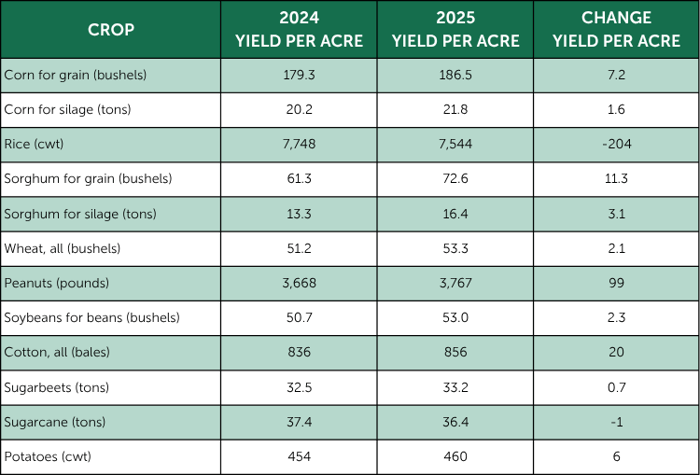
The largest percentage change in harvest yields in 2025 was sorghum for silage with an increase of 3.1 tons per acre, or a 23.3% increase. Sorghum for grain saw a similarly large increase of 18.4% or an additional 11.3 bushels per acre, which is especially impressive after an increase of 9.3 bushels per acre in 2024.
Peanuts rebounded a little bit this year, increasing by 99 pounds per acre (2.7%), after a decrease of 73 acres or (-2%), after a decrease of 277 pounds per acre (-7%), in 2023. Despite the increase, yields are not back to 2022 levels. Potatoes also saw an increase this year of 6 cwt per acre (1.3%) after a decrease of 5 cwt per acre (-1.1%) in 2024, meaning yield is similar to 2023.
Soybeans for beans, all wheat, corn for grain, and corn for silage also all experience yield increases of 4% or better.
Overall, the story seemed to be a general yield increase across crops for a variety of reasons. A lot of the growth in sorghum can be attributed to new hybrids that were created with marker-assisted selection to increase yield and resist heat and drought. Both sorghum and other crops are seeing benefits from the implementation of AI in seed production as well - predictive modeling and sequencing and mapping will only help to continue those increases.
For a full look into the Prospective Planting data from this year's report as well as others, check out the USDA website here.
.png?width=352&name=2025%20Prospective%20Plantings%20(April%202025).png)